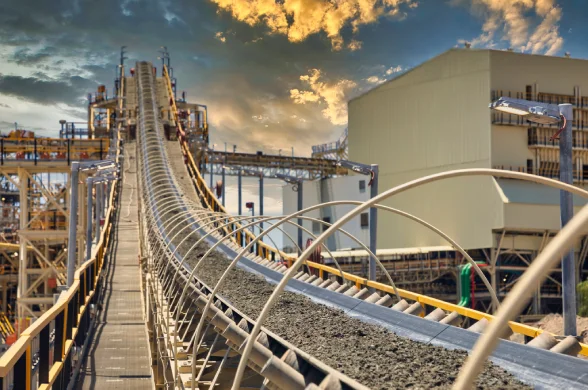
Continuous Online Analysis for Gold Mining Operations
GEOSCAN GOLD uniquely measures precious metals directly as low as 0.1ppm in conveyed flows over 10 minute parcels of flow. Improve ore grade control, optimise processing efficiency and maximise gold recovery with continuous online analysis of gold ores and process streams.
Every stage of a gold operation depends on understanding ore quality, composition and moisture. Variations can reduce recovery, increase costs and impact process performance.
GEOSCAN GOLD provides continuous online analysis to help producers reduce variability, optimise ore blending, improve feed consistency and enhance process control. Measurements of elements such as sulphur, carbon and mineralogy indicators can support reagent dosing, flotation and roaster control. GEOSCAN GOLD also helps improve ore reconciliation, metal accounting and moisture management, enabling better production decisions, improved process stability, increased gold recovery and lower operating costs.
Accurate ore grade information is essential for maximising recovery and minimising dilution. Variations in ore grade and moisture can impact mill performance, recovery rates and overall plant efficiency.
Scantech’s continuous online analysis solutions provide continuous measurements of run of mine (ROM) ore, primary crusher discharge, conveyor transfer points and mill feed, giving operators greater visibility of ore quality throughout the production process. Continuous measurements support improved ore routing, stockpile management and blending strategies, helping maximise plant performance and recovery.
Key Benefits
Improve ore grade control
Reduce ore dilution
Improve mill feed consistency
Increase plant throughput
Improve production planning
Maximise resource utilisation
Bulk ore sorting
Ore Reconciliation and Metal Accounting
Accurate ore reconciliation is critical for validating tonnage, grade and metal movement between the mine, stockpiles and processing plant. Ore reconciliation helps operators identify and manage variances by comparing predicted grades from geological block models and mine schedules with actual plant feed, improving mine planning, grade control and processing. Accurate gold and moisture measurement of plant feed provides a definitive gold quantity entering the process that is utilised in conjunction with tailings and product gold content for metallurgical accounting in process operations.
Scantech’s continuous online analysis solutions continuously monitor run of mine (ROM) ore, stockpile conveyors, transfer conveyors and mill feed, providing continuous information on ore quality throughout the production process. Continuous measurements support more accurate reconciliation, improve resource tracking and help optimise production planning. Gold measurement for metal accounting assists operators to identify and manage variances and optimise process performance including maximising gold recovery and reducing operating costs.
Key Benefits
Improve ore reconciliation
Support metallurgical accounting for performance tracking, auditable production data, and loss detection
Improve production reporting
Verify ore quality (not just grade)
Improve resource tracking
Increase operational confidence
Stockpile Management & Ore Blending
Variability in ore chemistry and moisture can significantly affect downstream processing performance. Effective stockpile management and ore blending help maintain a consistent plant feed and maximise recovery.
Scantech’s continuous online analysis solutions continuously monitor ROM stockpiles, low-grade stockpiles, high-grade stockpiles and blended ore streams, providing accurate information to optimise stockpile building, reclaiming and ore blending. By understanding material quality before it enters the plant, operators can reduce variability and deliver a more consistent feed to downstream processes.
Key Benefits
Improve feed consistency, increasing process efficiencies
Optimise ore blending
Reduce process variability
Improve recovery performance
Maximise stockpile utilisation
Increase operational confidence
Mill Feed Optimisation and Feed Forward Control
Maintaining a consistent mill feed is critical for achieving stable operating conditions and maximising gold recovery. Variations in ore composition and moisture can reduce milling efficiency and impact downstream processing performance.
Scantech’s continuous online analysis solutions continuously monitor mill feed conveyors, transfer conveyors and process feed streams, enabling operators to identify changes in ore characteristics early and make informed process adjustments before they affect production. These adjustments may include flow control to the mill for different grinding characteristics or reagent addition control for differences in ore quality, including acid-consuming gangue content. Operational geometallurgical applications can be used to indicate changes in mineralogy that affect process performance through ore and waste type change detection and characterisation. Continuous elemental and moisture measurements support improved mill performance, increased recovery and greater operational efficiency.
Key Benefits
Improve process stability
Increase gold recovery
Optimise process chemistry
Optimise mill performance
Reduce process variability
Improve operational efficiency
Moisture Management
Moisture influences material handling, blending, stockpile management and metallurgical accounting. Accurate moisture information is essential for efficient processing and reliable production reporting.
Scantech’s continuous online analysis solutions continuously monitor run of mine (ROM) ore, concentrates, stockpiles and transfer conveyors, providing accurate moisture information throughout the operation. Continuous moisture measurement supports blending accuracy, improves process control and enhances operational efficiency.
A gold mining company in the USA employed a ReadiMoist TBM for feed moisture measurement for dry tonnage determination to ensure compliance with a statutory dry tonnage processing limit. The over-generous moisture factor previously applied limited their throughput. The moisture analyser in conjunction with some other changes resulted in a 3% increase in feed rate and still comply with their limit. The increase in gold value in ore feeding the process was well over USD 50M per year. A published presentation is available on this (Bozbay and Moyo, 2019).
Key Benefits
Improve moisture control
Optimise blending
Improve material handling
Support metallurgical accounting
Increase operational efficiency
Improve production reporting
Why Continuous Online Analysis?
Laboratory testing remains an essential part of quality assurance, providing highly accurate analysis of sampled materials. However, laboratory results are typically based on periodic samples and are only available after the material has already moved through the process.
Continuous online analysis complements laboratory testing by continuously monitoring the entire material stream as it is conveyed. This provides operators with immediate process information, enabling earlier identification of material changes, faster process adjustments and improved control over product quality and plant performance.
Limitations of Traditional Laboratory Testing
Periodic sample analysis, involving large samples necessitated by nugget effect
Results available after sampling, significant delay irrespective of assay technique
Represents only a small portion of the material stream
Benefits of Continuous Online Analysis
Continuous measurement across the entire material stream
Immediate process information
Continuous elemental and moisture monitoring, representative irrespective of particle size, belt speed, mineralogy or compositional distribution
Earlier identification of ore variability
Improved grade control and blending
Increased plant stability and improved feed forward control
Does on-conveyor analysis replace laboratory testing?
No. On-conveyor analysis provides continuous operational data, while laboratory testing remains important for certification and reconciliation. The systems complement each other. Analyser measurement data has become increasingly of interest for ore reconciliation and metal accounting as it represents the plant feed better than sampling at most sites.
How quickly is measurement data available?
Measurement data is available in near real time as material passes the analyser, allowing operators to respond to variability within operational timeframes rather than waiting for batch results. In direct precious metal measurement typical measurement times are 10 minutes for gold and silver but 30 seconds for other elements.
Is the analyser affected by dust or harsh mining environments?
Scantech systems are designed for demanding industrial environments and are engineered to operate reliably under typical mining conditions.
Can systems be upgraded as plant requirements change?
Yes. Systems are designed to be upgradable in the field, allowing electronics and software components to be updated as requirements evolve.
How is radiation managed in gold applications?
Where applicable, radiation safety is managed through established compliance procedures, monitoring and support services to ensure safe operation. In most jurisdictions the low radiation levels around the analyser do not require any isolation area around the unit.